Let’s get the most important thing out of the way first: you cannot visit both towers with one ticket. Once you’ve made your choice, it’s locked in—so getting it right matters.
The Sagrada Familia has eighteen towers in its completed design, but in 2026, only two are open to visitors: the Nativity Tower on the eastern side and the Passion Tower on the western side. Both offer spectacular views and a unique perspective on Gaudí’s masterpiece, but they provide noticeably different experiences. Neither is objectively better—but one may suit your visit more than the other.
The Short Answer: Which One Should You Choose?
Choose the Nativity Tower if... | Choose the Passion Tower if... |
|---|---|
You want to experience Gaudí’s original work (the only façade he completed in his lifetime) | You want the broadest, most dramatic panorama over Barcelona |
You’re visiting in the morning (east-facing, beautiful morning light) | You’re visiting in the late afternoon (west-facing, golden sunset light) |
You want the bridge walk between the towers—a memorable feature the Passion side lacks | You want maximum height—it’s roughly 20 metres taller |
You appreciate intricate, naturalistic stonework and architectural detail | You want wider, more open viewing platforms and a more modern feel |
You’re travelling with kids (gentler descent) | You don’t mind a narrower, steeper descent (60 steps vs 50) |
Source: Juntos Tour y Yo: Which tower to climb at the Sagrada Familia? Nativity vs. Passion (Guide 2026)
The Nativity Tower: Gaudí’s Own Hand
The Nativity Façade on the eastern side of the basilica is the oldest section of the building—and the only one that Gaudí worked on directly during his lifetime. For Gaudí enthusiasts, this is as close as you’ll get to the master’s original touch.
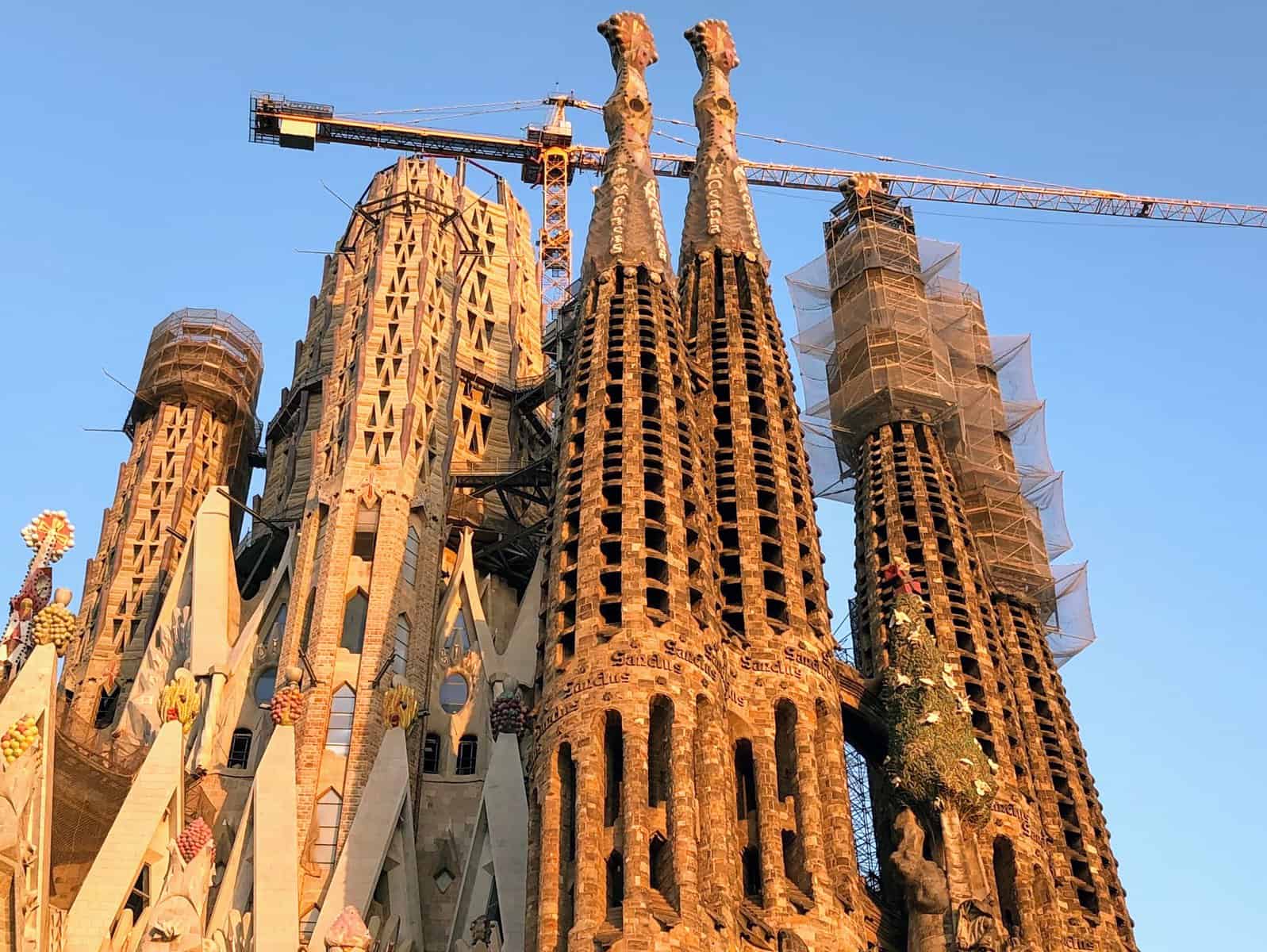
What you’ll see: You look out over the eastern side of Barcelona toward the Mediterranean Sea. You’ll see the Agbar Tower, the coastal district of Poblenou, and the distant hills of Maresme. From the tower bridges, you’re inches away from the intricate carvings of birds, flowers, and the famous "Tree of Life".
The experience: The Nativity towers feel more organic. The bridges are slightly narrower, and the stone feels weathered and historic. The view opens east, over the older grid of the Eixample toward the sea.
Best time for photos: Morning (9:00 AM – 11:00 AM). The sun rises behind you, illuminating the city and the Mediterranean in a bright, crisp light.
Height: Approximately 55 metres.
Descent: 50 steps, gentler than the Passion Tower.
The Passion Tower: The Photographer’s Panorama
The Passion Façade came later, built in a starker, more angular style. It stands noticeably taller—around 75 metres against the Nativity tower’s 55. That extra height buys a wider, more dramatic sweep of the city centre and the hills behind it.
What you’ll see: This is the ultimate "Barcelona Grid" view. You look directly down the Avinguda de Gaudí and across the Eixample district toward Tibidabo Mountain and Montjuïc Hill. You’re also closer to the central Tower of Jesus Christ—now completed at 172.5 metres in 2026.
The experience: Because these towers are newer and taller, the bridges often feel a bit more open and provide a greater sense of height. It’s arguably the more thrilling climb.
Best time for photos: Late afternoon (3:00 PM – sunset). As the sun sets over Tibidabo, it casts long, dramatic shadows across the city and floods the towers with a deep orange glow.
Height: Approximately 75 metres.
Descent: 60 narrower steps, steeper than the Nativity Tower.
Source: Visiting Gaudi's Sagrada Familia Towers-Lions in the Piazza
The 2026 Difference: The Central Tower Is Complete
In 2026, both towers offer a view that didn’t exist just a few years ago: the Tower of Jesus Christ. It reached its full height of 172.5 metres on 20 February 2026, making the Sagrada Familia the tallest church in the world. It was inaugurated by Pope Leo XIV on 10 June 2026.
From the Nativity Tower, you get a spectacular side-profile of the central tower and the four Evangelist towers. It feels like being inside a mountain range made of stone.
From the Passion Tower, you are closer to the central axis, giving you a better sense of the sheer scale and the 17-metre cross that now crowns the city.
What to Expect: The Climb
However you choose, the climb works the same way in both towers:
You ride an elevator up (45 seconds, capacity approximately 7 people)
You spend 10 to 15 minutes at the top viewing area
You descend on foot through a narrow spiral staircase built right into the stone
The exact number of steps depends on which tower you choose—plan on somewhere around 300 to 500 tightly wound steps. The Nativity Tower has around 300 steps, while the taller Passion Tower involves more.
Important: The descent is the limiting factor. It’s not a hard climb in the physical sense—the elevator does the heavy lifting—but the staircase is narrow and spirals the whole way down.
Safety and Restrictions
Restriction | Details |
|---|---|
Minimum age | 6 years old officially, but realistically 8 for the descent |
Maximum capacity | 1 person per stair on the descent |
Closures | Tower access closes in heavy rain and strong wind |
Bag size | No bags larger than 40 cm allowed in the elevator |
Photography | Selfie sticks and tripods are banned |
Children | Children under 6 are not allowed in the towers at all |
How to Book Tower Access
Tower access is sold as an add-on or in the Top View ticket (around €40)
Basic admission is €26 (no towers); with towers it’s approximately €36
Book 30 to 60 days in advance—tower slots sell out faster than basilica tickets in peak season
You select the tower (Nativity or Passion) at booking time, not at the entrance
What It Is Actually Like on the Day: Notes From Recent Visitors
Almost every guide describes the towers. Very few describe the hour around them — the security queue, the entry window, the stairs, and the moment you realise the weather has decided the value of your ticket for you. These notes come from visitors who did the self-guided tour with tower access.
Your entry window is wider than your ticket says
Tower and basilica are booked as two separate time slots. With a timed ticket you may enter from 15 minutes before your slot and up to 30 minutes after it. Visitors also report being allowed back into the basilica after coming down from the tower, so the order of your two slots matters far less than the booking page implies — do the tower first if the sky is clear, and save the interior for later.
Security is run like an airport
Bags go through a scanner and you walk through a metal detector. Belts and anything metal come off; shoes stay on. At busy slots this is the part that eats your buffer, which is the real reason to arrive at the start of your window rather than the end.
Getting there, and what it costs
There is a Metro station directly in front of the basilica (Sagrada Família, lines L2 and L5), so public transport drops you at the door. Visitors travelling as a group of three found a taxi from a central hotel cost a little over €10 — effectively the same as three single Metro fares, and dry in the rain. Solo travellers and couples save with the Metro or a T-casual multi-trip ticket.
Do not buy your ticket at the door
There is a tourist information point on the street outside, but visitors were told same-day tickets were sold out. Tower slots in particular go weeks ahead in high season.
Up by lift, down by spiral staircase
You ride a lift up, step out, climb a short flight and come out on the open platform between the two towers — that platform, not the stairwell, is where the views are. You then cross into the adjacent tower and walk down a tight spiral staircase. Visitors describe it as genuinely disorienting, one noting they felt dizzy at the bottom. There are emergency phones inside the towers, and staff will arrange assistance if someone cannot complete the descent.
The towers are still a building site
Expect construction noise at the top. It is an active site, not a finished viewing gallery.
Weather decides whether the tower is worth it
On a grey, rainy day the panorama largely disappears, and one visitor was blunt: given the same choice again, they would skip the towers and spend the money elsewhere in Barcelona. Weather matters inside too — the east windows glow blue and green in the morning light, the west windows burn red and orange in the afternoon, and on an overcast day neither performs.
Two things below ground most visitors miss
Gaudí is buried in the crypt beneath the basilica, in the Chapel of Our Lady of Mount Carmel — but visitors report it is generally only accessible around mass, and closed otherwise. Downstairs you will also find the museum, shop and restrooms, and you can go back up into the basilica afterwards. The museum holds Gaudí’s original sketches, plaster models, the famous hanging-chain models he used to work out how the structure would carry its own weight, and the workshop where craftspeople still cut pieces for the building today.
What changed in 2026 — and what changes in 2027
On 20 February 2026 workers lifted the final arm of the 17-metre cross onto the Tower of Jesus Christ, taking the building to 172.5 metres and making it the tallest church in the world — taller than St Peter’s in Rome. The height is deliberate: Gaudí set the summit one metre below Montjuïc, Barcelona’s highest natural point, so that human work would not top nature. 2026 is also the centenary of Gaudí’s death, with a commemorative mass on 10 June and the lighting of the Nativity façade in December. The viewing platform inside the cross itself is expected to open to visitors around 2027 — if a 172-metre viewpoint is the reason you are going up, that is the year to wait for.
Frequently Asked Questions
Is it worth going into the towers at Sagrada Familia?
For most visitors, yes. The towers offer a perspective on Gaudí’s architecture and Barcelona that you simply cannot get from the ground. As one visitor put it, “it's awesome to see the other towers up close from your tower and all the symbolic masonry up there”. The views are 7/10, but the architectural experience is what makes it special.
Which side of the Sagrada Familia Tower is better?
It depends on what you want. The Nativity Tower offers Gaudí’s original craftsmanship, a bridge walk, and morning light. The Passion Tower offers greater height, wider city panoramas, and golden afternoon light.
What is the difference between Sagrada Familia towers?
The Nativity Tower is shorter (55m), older, and features Gaudí’s original organic, ornate style. The Passion Tower is taller (75m), built later in a starker, angular style, and offers broader views.
Do you need to climb or take an elevator to get up the Sagrada Familia Tower?
You take an elevator up and walk down a narrow spiral staircase.
How many steps are in the Sagrada Familia Tower?
Around 300–500 steps, depending on which tower you choose.
Is there a dress code for Sagrada Familia?
Yes. The Sagrada Familia is an active place of worship. Dress appropriately: cover shoulders and knees, no see-through clothing, no swimwear, and remove hats inside.
Will Sagrada Familia be finished in 2026?
The structure is complete. The Tower of Jesus Christ reached its full height in February 2026. However, the basilica is still only about 80% complete. The Glory Façade and final decorative work are expected to continue until around 2035–2036.
Is Gaudí buried in the Sagrada Familia?
Yes. Gaudí is buried in the crypt of the Sagrada Familia, specifically in the chapel of Our Lady of Mount Carmel.
Should you do Sagrada Familia and Park Güell on the same day?
It’s possible but ambitious. Both attractions are popular and time-consuming. Most guides recommend visiting them on separate days to avoid rushing.
Is Sagrada Familia with towers worth it?
If you’re comfortable with heights and narrow stairs, yes. The towers offer a perspective on Gaudí’s architecture and Barcelona that you can’t get anywhere else. As one source puts it, “they are, as Gaudí intended, a fundamental part of the experience”.
Final Verdict: Which Tower Should You Choose?
There’s no single right answer—but here’s a simple decision framework:
If you want... | Choose... |
|---|---|
Best overall views and sunset | Passion Tower |
Gaudí’s original work and architectural detail | Nativity Tower |
Visiting in the morning | Nativity (east-facing, morning light) |
Visiting in the late afternoon | Passion (west-facing, golden light) |
The bridge walk between towers | Nativity |
Maximum height and the widest panorama | Passion |
A first-time visit wanting the “essential Gaudí” experience | Nativity |
Neither tower is the wrong choice. You’re picking between Gaudí’s original vision lit by the morning sun, or a taller, starker viewpoint over the heart of the city. That’s a different experience, not a coin flip.
And in 2026—marking a hundred years since Gaudí’s death—climbing his towers feels like more than sightseeing. It feels like standing inside history.
For more travel inspiration, explore Hummly's travel insights and follow Henry Schulz for more Barcelona tips.