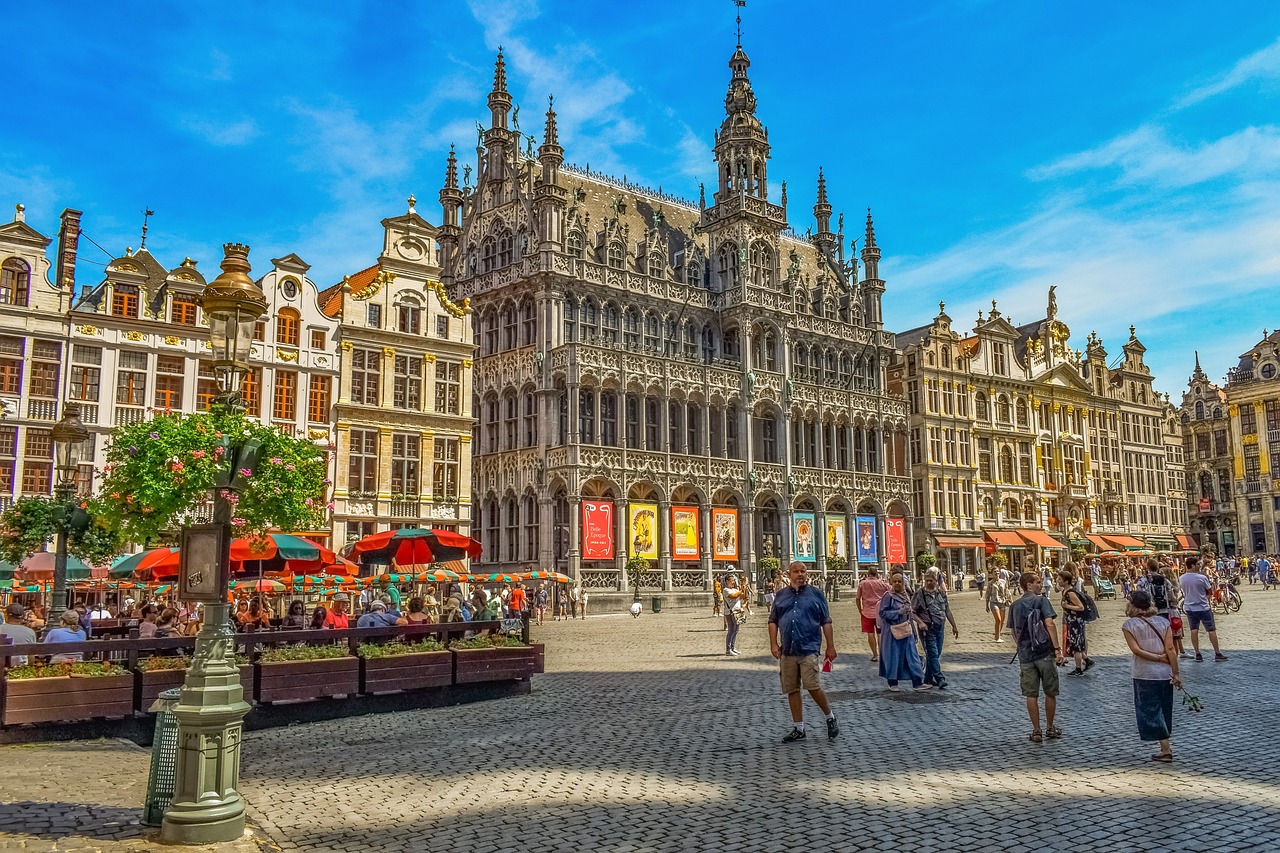
Short answer: the best time to visit Brussels is mid-May to early June, followed closely by September. Those weeks give you daytime highs of roughly 18–21 °C, the longest usable daylight of the year, terrace weather on the Grand Place, and noticeably fewer people than July and August — when Brussels itself is busy and its day-trip neighbours, Bruges above all, are overwhelmed.
But "best" depends on what you came for. Below is the month-by-month picture using 30 years of Brussels weather records, plus the practical details that only come from people who have actually walked the city: how the airport trains work, why your travel pass can quietly waste a day, which crowds are avoidable and which are not, and what to do when it rains — which, in Brussels, it will.
Brussels weather month by month
These are 30-year averages (1994–2023) for central Brussels, calculated from daily reanalysis records via the Open-Meteo historical archive. Rain days count any day with at least 1 mm.
| Month | Avg high | Avg low | Rainfall | Rain days | What it feels like |
|---|---|---|---|---|---|
| January | 6 °C / 43 °F | 2 °C / 35 °F | 66 mm | 13 | Coldest month. Grey, damp, cheap, empty museums. |
| February | 8 °C / 46 °F | 2 °C / 36 °F | 61 mm | 12 | Still winter, but light is returning. Lowest hotel prices. |
| March | 11 °C / 51 °F | 3 °C / 37 °F | 59 mm | 12 | Shoulder season. Coat weather, good value, quiet Bruges. |
| April | 14 °C / 58 °F | 5 °C / 42 °F | 46 mm | 11 | Driest month of the year. Showery but bright. |
| May | 18 °C / 64 °F | 9 °C / 48 °F | 64 mm | 12 | The sweet spot. Terraces open, parks green, crowds moderate. |
| June | 21 °C / 70 °F | 12 °C / 54 °F | 67 mm | 11 | Longest days, ~16 hours of light. Excellent — book early. |
| July | 23 °C / 72 °F | 14 °C / 58 °F | 72 mm | 12 | Hottest month, tied with August. Peak crowds and prices. |
| August | 23 °C / 72 °F | 14 °C / 58 °F | 72 mm | 12 | Hot, humid, thundery. Bruges is at its worst for crowds. |
| September | 19 °C / 67 °F | 12 °C / 53 °F | 55 mm | 11 | The connoisseur's month. Warm, drier, calmer. |
| October | 15 °C / 59 °F | 9 °C / 48 °F | 63 mm | 12 | Autumn colour in Brussels Park. Museum weather. |
| November | 10 °C / 50 °F | 5 °C / 41 °F | 65 mm | 12 | Dark and wet, then Christmas markets arrive late in the month. |
| December | 7 °C / 44 °F | 2 °C / 36 °F | 74 mm | 13 | Wettest month — but the Grand Place at night is unmatched. |
Three numbers worth remembering: December is the rainiest month (74 mm), April is the driest (46 mm), and July and August are the hottest (23 °C average highs). Nothing here is extreme. Brussels does not get properly hot the way Seville or Rome does, and it does not get properly cold the way Vienna does. What it does, reliably, is rain a little on about one day in three, all year round. Every experienced visitor says the same thing: carry a light waterproof, and do not plan a day that collapses if the sky opens.
Season by season: what you actually get
Spring (March–May): the best value of the year
April is statistically the driest month in Brussels and May is the first month that genuinely feels like holiday weather. Parks matter here more than people expect — Brussels Park sits between the government buildings with tree-lined paths and fountains, Leopold Park in the European Quarter is a surprisingly good place to lie down and forget about politics, and the Parc du Cinquantenaire around the triumphal arch is where locals go to sit in the sun. None of that works in February.
Spring is also when day trips are at their most pleasant. Bruges in March on a weekday is close to the city that guidebook readers fell in love with twenty years ago; Bruges in August is a queue.
Summer (June–August): long days, real crowds
Summer gives you around sixteen hours of usable light in late June, evening terraces, and the one genuinely seasonal attraction in the city: parts of the Royal Palace open to the public during the summer months only, on selected days, with advance booking required. If seeing the state rooms matters to you, summer is your only window.
The trade-off is volume. Travellers who first visited Bruges in the mid-2000s and returned recently describe roughly twenty times the number of people at the Rozenhoedkaai viewpoint, boat-tour queues of about an hour for a 35-minute ride, and long lines for the horse carriages. Their advice, and it is good advice: come on a weekday, avoid peak summer if you can, and if you cannot, arrive early and stay late. At 6 p.m. the day-trippers leave and the famous canal view empties out — the swans come back and you can stand on the spot without jockeying for it.
Autumn (September–October): the quiet winner
September is drier than July and August (55 mm versus 72 mm), still warm at 19 °C, and materially calmer. October brings the first real museum weather. If your priority is the interiors — the Royal Museums of Fine Arts, the Musical Instruments Museum, Autoworld, the BELvue Museum next to the Royal Palace — autumn is when you have them to yourself.
Winter (November–February): cheap, dark and surprisingly magic
December is the wettest month and January the coldest, and it is still a defensible time to come. Hotel rates fall, the museums are empty, and Brussels at night in winter is the city at its best: the Grand Place illuminated with the crowds thinned out is the single most repeated recommendation from people who have been there. Add the Christmas market season from late November, and the Galeries Royales Saint-Hubert — an 1847 glass-roofed arcade nicknamed "the umbrella of Brussels" — becomes a genuinely useful place to spend a wet hour eating waffles.
Is Brussels worth visiting?
Yes — with a caveat that the tourist board will not tell you. Brussels is a two-to-three-day city, not a week-long one, and some of its headline attractions are underwhelming on purpose.
What is genuinely excellent: the Grand Place, regularly voted the most beautiful square in Europe, surrounded by gilded guild houses rebuilt in stone after French troops destroyed the square over three days in 1695, and a UNESCO World Heritage Site since 1998. The Town Hall interior — council chamber, wedding hall, and a grand ceremonial hall that visitors compare to Windsor Castle with more red and gold. The Cathedral of St Michael and St Gudula, free, worth twenty minutes. The Atomium, a 1958 World's Fair structure representing an iron crystal magnified 165 billion times. The Galeries Royales Saint-Hubert. And Autoworld in the Cinquantenaire, which car people rate among the best collections in Europe, Lancia rally section included.
What is overrated, honestly: Manneken Pis is much smaller than photographs suggest and mildly disappointing in person — although the story is better than the statue (records from around 1388 describe a stone fountain of a peeing boy distributing drinking water; the bronze dates from 1619, it survived the 1695 bombardment, and the costume tradition began in 1698, with over a thousand outfits now kept in the GardeRobe museum). The costume museum, the fries museum and the chocolate museum are all skippable unless you are short of ideas. And the European Quarter — Parliament, Parliamentarium, House of European History — is free but, in the words of more than one visitor, very dull unless you actively like politics. Note that Parliament requires advance booking and your passport at the door.
One thing almost everyone gets wrong at the Atomium: most people take the lift to the top sphere, spend ten minutes, and leave. The other spheres — construction exhibitions, light shows, a room that resembles a techno club — are only reachable by going back down and using the escalators, and the signage does not make that obvious. If you are epileptic, skip the light spheres.
How many days in Brussels is enough?
Two full days covers the historic centre comfortably — everything inside the ring road is walkable, and it is where most of what you want to see sits. Three days lets you add the outer attractions that need a tram or metro: the Atomium and Mini-Europe to the north, the Cinquantenaire museums to the east, and the National Basilica of the Sacred Heart, one of the world's largest basilicas, free to enter, with an €8 lift ticket to a dome panorama. Fair warning on that dome: the floors are uneven, the wind is strong, and visitors with no history of vertigo have reported feeling genuinely sick up there.
Four to five days in Belgium is the sweet spot, using Brussels as a base and giving one day each to Bruges, Ghent or Antwerp.
Bruges or Brussels? And what about Ghent and Antwerp?
They are not competitors — Bruges is about an hour from Brussels by train, with departures every 30 minutes, and a weekend return can cost around €18. Ghent is half an hour away, Antwerp about forty minutes. All three are day trips.
- Bruges is the prettiest and the most crowded: a medieval trading power that built the world's first stock exchange in 1309, then declined when the Zwin channel silted up after 1500 and trade moved to Antwerp. Highlights are the Church of Our Lady (Michelangelo's Madonna, roughly €7 extra for full access — budget 30–45 minutes), the Belfry's 366 steps, Burg Square, and the Rozenhoedkaai view. A three-day Bruges museum card is about €33 and pays off from three or four attractions.
- Ghent is the underrated one: multiple market squares rather than one, a belfry with a lift most of the way up, and Gravensteen castle — book ahead, it sells out, and the free audio guide is unexpectedly funny.
- Antwerp is the low-tourist favourite: Rubens in the cathedral, the Red Star Line emigration museum, the Plantin-Moretus printing museum (the only museum that is itself a UNESCO World Heritage Site, twice over), and an Antwerp City Pass that bundles museums plus 24 hours of transport. Visitors consistently describe it as calmer and more relaxing than Brussels.
Asked to pick one, seasoned travellers split: Bruges if you are a photographer, Antwerp if you want culture without crowds. Is Brussels or Amsterdam better? Amsterdam has the stronger museums and the bigger name; Brussels is cheaper, far less crowded, better for food, and easier to use as a base for four cities in a week. If you have three days for one city, Amsterdam. If you have five days for a country, Belgium.
What to pack, and how people dress
Two things ruin more Brussels trips than the weather: the wrong shoes and no rain layer. The centre is highly walkable but the streets are cobbled, and cobbles punish thin soles and heels. Belgians dress neatly and unflashily — dark jeans or trousers, a decent jacket, real shoes, an umbrella. Athletic wear worn as everyday clothing, baseball caps and loud logos are the things that read as visiting American; nobody minds, but if you would rather blend in, that is the adjustment. And a plain practical note that keeps coming up: pickpockets work the busy bars and squares. One traveller's friend nearly lost her handbag inside Delirium Café, and a solo visitor walking back late near the Grand Place was approached in a way that frightened her badly. Stay aware after dark, prefer hotels with staffed reception over unattended apartments if you are travelling alone.
Food and drink: what to actually eat
Belgian fries are fried twice, sometimes in beef fat, served in a paper cone with a wall of sauces. Maison Antoine near the European Parliament is the famous one; Fritland is the crowd favourite near the Grand Place, and Frit Flagey has its own devotees. Waffles come in two forms — the light rectangular Brussels waffle and the smaller, sweeter, caramelised Liège waffle. Maison Dandoy is the historic name, a bakery dynasty dating to 1829 whose speculoos biscuit became a national staple; buy a jar of speculoos spread to take home. Moules-frites is the dish to order if you like seafood. And chocolate is not a cliché here: Neuhaus, founded as a pharmacy in 1857 in the Galeries Royales, invented the filled praline in 1912, and its original boutique still trades in the same arcade.
For beer, the old Stock Exchange is now an interactive beer museum with a rooftop bar — and the lift to the roof is free even without a ticket, though service is slow when it is busy. Delirium Café claims over 2,000 beers across several floors. What drink is famous in Belgium? Beer, specifically Trappist ales brewed by monks, and lambics; Belgium produces hundreds of styles, from light lagers to ales strong enough to end an evening early.
Getting in and getting around
- Brussels Airport (Zaventem): the train from inside the airport reaches Brussels Central in about 20 minutes, and Central is walking distance from the Grand Place. An airport bus serves the European Quarter if your hotel is that side.
- Brussels South Charleroi, used by budget airlines, is not in Brussels — it is about an hour away. Take the shuttle bus from the airport bus terminal (usually platform 1) to Brussels-Midi; roughly €20 one way, cheaper as a return.
- City transport: buy a multi-day pass from a machine in any metro station. The important quirk — a day pass counts from the calendar day you first use it, not from the hour of activation, so validating one at 11 p.m. burns a full day. Contactless bank cards at the turnstiles are unreliable in practice; stick with a machine-bought ticket. On metro you need the pass to exit as well as enter; on trams and buses you tap once, and you often have to open the doors yourself.
- Where to stay: near Brussels Central or the Grand Place, which puts almost everything on foot. Anywhere with a metro or tram stop works. The area immediately around Brussels-Midi/South station is convenient for trains but the least appealing at night — fine for a one-night stopover, not where a first-time visitor should base a week.
Two small things that pay for themselves: download an offline map before you arrive, and get an eSIM so you have data without roaming charges.
Frequently asked questions
What is the best month to go to Belgium?
May, June or September. May and September give the best balance of weather and crowds; June has the longest daylight but higher prices.
What is the rainiest month in Brussels?
December, averaging about 74 mm across 13 wet days. July and August are close behind at 72 mm, but their rain arrives as short thunderstorms rather than steady drizzle.
Which month is the hottest, and which is the coldest?
July and August tie for hottest, averaging highs of 23 °C, with occasional heatwaves pushing well past 30 °C. January is coldest, averaging 6 °C by day and 2 °C at night. Hard frosts happen; deep snow is rare and rarely lasts.
Does Belgium get hot in the summer, and is it humid?
Typically it is pleasantly warm rather than hot, but the maritime air makes summer feel muggy, and August storms are common. Air conditioning is not standard in older hotels — worth checking if you are sensitive to heat.
Is it safe for Americans to visit Belgium, and are Belgians friendly?
Belgium is a safe, stable EU country and Americans need no visa for short tourist stays (an ETIAS travel authorisation is being phased in — check the current requirement before you book). Belgians are polite and reserved rather than effusive; that reads as cool if you expect American-style warmth, but it is not unfriendliness. Petty theft in tourist crowds is the realistic risk, not violence.
Do and don'ts in Belgium?
Do greet people before asking a question, say bonjour or goedendag, and let them switch to English — nearly everyone can. Do tip modestly by rounding up; service is included. Do keep your voice down on public transport. Don't assume everyone speaks French: Brussels is officially bilingual French and Dutch, Belgium has three official languages including German, and the language question is genuinely sensitive. Don't call Belgian fries French, don't lump Belgium in with the Netherlands, and don't photograph people without asking.
What should I bring back from Brussels?
Pralines from Neuhaus or a local chocolatier, Dandoy speculoos biscuits and speculoos spread, Trappist beer with the matching glass, lace from Bruges, and a comic album — Tintin, the Smurfs and Lucky Luke were all created here, and you will see them painted on walls across the city.
What is the number one thing to do in Brussels?
Stand in the Grand Place twice: once in daylight to read the guild houses and go inside the Town Hall, and once after dark when the façades are lit and the crowds have gone. Everything else in the city is optional. That is not.
So, when should you book?
If you want the best weather-to-crowd ratio, book mid-May to early June or the first three weeks of September. If you want the lowest prices and empty museums, book late January to March and plan around the rain. If you want Christmas markets and the Grand Place lit up, take late November to December and accept the wettest month of the year. And whenever you come, keep one day free for Bruges, Ghent or Antwerp — Brussels is a fine capital, but Belgium is the reason to make the trip.